
Senior Flight Attendant Jan Brown survived the catastrophic crash of United Airlines Flight 232 before turning the tragedy—and the loss of young Evan Tsao—into a lifelong campaign for improved child safety in the skies.
On July 19, 1989, United Airlines Flight 232 crashed while attempting an emergency landing at Sioux Gateway Airport (SUX) in Sioux City, Iowa.
Of the 296 people on board, 184 ultimately survived an accident that the National Transportation Safety Board (NTSB) later concluded had made a safe landing “virtually impossible,” long before the heroics of Captain Chesley “Sully” Sullenberger and the Miracle on The Hudson.
The scenario has since been studied extensively in flight simulators. Although limited control could be achieved using differential engine thrust, pilots could not reliably control the aircraft’s speed, attitude, direction and rate of descent simultaneously.
Yet, on that sunny afternoon, Flight 232’s crew somehow guided their crippled McDonnell Douglas DC-10 to an airport. Their extraordinary teamwork, combined with the preparations made by the cabin crew and the rapid response of emergency services, gave those on board a chance of survival.
Leading the cabin crew was senior flight attendant Jan Brown, a woman who has long been one of my aviation heroines.
I first learned about Jan through an interview she gave for the television documentary Black Box. Her calmness, professionalism and honesty left a lasting impression on me.
You can therefore imagine my excitement when I received an email from Jan herself. She had read my Angels of the Sky story and wanted to speak to me.
Jan shared her memories of that terrible day and told me about the tireless campaign that has shaped her life ever since: her determination to end the practice of allowing children under two to travel unsecured on an adult’s lap.
This is her story.

Just Another Day At The Office
Earlier that day, a United Airlines McDonnell Douglas DC-10-10, registered N1819U, was prepared for a scheduled flight from Denver’s Stapleton International Airport to Philadelphia, with an intermediate stop at Chicago O’Hare.
Eight flight attendants readied the cabin under Jan’s leadership. On the flight deck, Captain Alfred “Al” Haynes, First Officer William Records and Second Officer and Flight Engineer Dudley Dvorak completed their pre-departure checks.
Waiting to board were 285 passengers, including 52 children. Many families were taking advantage of United’s “Children’s Day” promotion, which allowed children to fly for one cent when accompanied by an adult.
Also travelling as a passenger was United DC-10 training check airman Captain Dennis “Denny” Fitch. He was off duty and returning home to see his family.
Nobody could have known how important his presence would soon become.
Flight 232 departed Denver at 14:09 Central Daylight Time. The climb to its cruising altitude of 37,000ft was uneventful, and the cabin crew began the meal service for the flight to Chicago.
Everything appeared completely normal.


Bleeding To Death
At 15:16, approximately one hour and seven minutes after take-off, a deafening bang erupted from the rear of the aircraft. The DC-10 shook violently, and some passengers and crew feared that a bomb had exploded.
On the flight deck, warning lights illuminated as the autopilot disconnected. The crew quickly determined that the tail-mounted No. 2 engine had suffered a catastrophic failure.
A fatigue crack, originating from a metallurgical defect in the engine’s stage-one fan disk, had caused the component to disintegrate. High-energy fragments tore through the aircraft’s tail, breaching all three independent hydraulic systems and rendering its conventional flight controls inoperative.
As the pilots worked through the engine shutdown checklist, Flight 232 entered a right descending turn. First Officer Records moved the control column hard to the left, but the aircraft did not respond. Captain Haynes took control and encountered the same terrifying problem.
With the DC-10 in danger of rolling inverted, the crew reduced thrust on the left, No. 1 engine. The aircraft gradually returned towards a wings-level attitude.
The pilots quickly realised that manipulating the two remaining wing-mounted engines asymmetrically was their only means of influencing the aircraft’s direction and attitude. Reducing power on one engine and increasing it on the other could produce a crude turn, while adjusting power on both could influence the nose.
However, every correction produced another unwanted movement. The aircraft continuously oscillated in pitch and had a persistent tendency to turn right.
United’s maintenance specialists could offer no procedure beyond those the crew had already attempted. A complete loss of all three hydraulic systems had been considered so unlikely that no checklist or training scenario existed.
They were on their own.
In the cabin, Jan and her colleagues knew that something serious had happened, but not the extent of the damage.
Jan explained: “Shortly before the 232 crash, my girlfriend and I were discussing what we would do in a situation such as United 811, where the cargo door had ripped off and taken out a section of business class passengers, and seats, and only the flight attendants in that area knew what had occurred. My friend said she would go to her jump seat, buckle up and hang on. That is exactly what I did immediately after our engine exploded as we did not know what had happened, but if it was a decompression, I did not want to be sucked out”.
Preparing The Cabin
Once Jan realised the aircraft had not suffered an explosive decompression, she made her way towards the front, calming and reassuring passengers as she went.
On the flight deck, Captain Haynes told her that the No. 2 engine had failed and that all three hydraulic systems had been lost. The DC-10 was only marginally controllable, and the crew intended to attempt an emergency landing at Sioux City.
Jan was instructed to prepare the cabin.
As she returned to brief her colleagues, Denny Fitch recognised the seriousness of the situation. He offered his assistance to a flight attendant, and the message was passed to the flight deck.
Haynes immediately invited him forward.
Fitch initially went back into the cabin to inspect the wings. He confirmed that the primary flight-control surfaces were not moving. Haynes then asked him to operate the two remaining throttles, freeing Haynes and Records to continue working together at the control columns.
The emergency unfolded over approximately 44 minutes, although Jan was not given a precise time for the aircraft to reach the ground.
The flight attendants secured meal-service equipment, stowed the trolleys and prepared their assigned sections. Passengers were shown the brace position, seat belts were checked, exits were identified, and those seated beside them were briefed.
The formal short-notice passenger briefing began at around 15:45, approximately 15 minutes before impact. The NTSB later confirmed that every passenger and flight attendant had adopted a brace position before the aircraft struck the runway.
The crew also had to prepare four adults travelling with small children who had been carried in their laps. Three of the children were under two, while one was 26 months old.
US regulations allowed children under two to be held by an adult without occupying their own seat or using a separate restraint. Under United’s emergency procedure at the time, parents were instructed to place their children on the floor and hold them there while assuming the brace position. Blankets and pillows could be used to provide additional cushioning.
Jan recalled: “Something that seemed so plausible in emergency training class seemed ludicrous in a real-life crisis.”

Disaster Strikes
As Flight 232 descended towards Sioux City, its crew jettisoned fuel and continued making constant thrust adjustments to maintain some semblance of control.
Approximately 11 minutes before impact, the landing gear was lowered using the alternate free-fall extension procedure. The gear increased drag, but the DC-10 remained dangerously fast because its flaps and slats could not be deployed.
Air traffic control had intended Flight 232 to land on the 8,999ft Runway 31. However, the aircraft had become aligned with the shorter, closed Runway 22.
Because of the DC-10’s position and its extreme difficulty making left turns, Haynes decided to continue towards Runway 22 rather than risk another attempt at manoeuvring.
For a few precious moments, it appeared they might make it.
During the final 20 seconds, however, Flight 232 was travelling at an average of 215 knots and descending at approximately 1,620ft per minute. At around 100 feet above the ground, the nose pitched down, and the right wing began to drop.
There was no time to recover.
The right wingtip struck the runway first, followed by the right main landing gear and the No. 3 engine. Fuel ignited immediately as the DC-10 cartwheeled and broke into several major sections.
The cockpit and tail separated, while the centre fuselage rolled inverted and came to rest in a cornfield. The engines and landing gear were torn away as wreckage was scattered across the airport.
The appalling impact was captured by television news cameras that had gathered after hearing about the unfolding emergency.
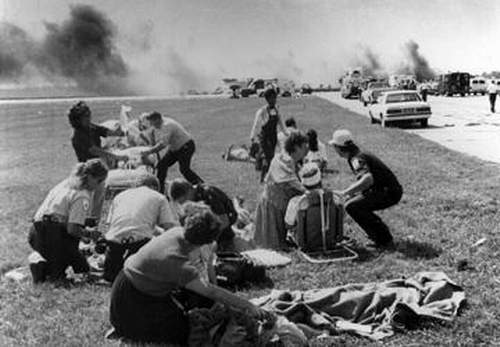
Emergency crews had been waiting and began their response immediately. Because of the violence of the crash, many initially feared that nobody could have survived.
As rescuers approached the wreckage, however, people began emerging from the cornfield. One emergency worker later recalled initially thinking that a school group had somehow been caught on the airfield.
They were, in fact, the survivors of Flight 232.

Miracle Survivors
Of the 296 passengers and crew members on board, 125 sustained minor injuries and 13 escaped without physical injury.
A total of 112 people ultimately died, including flight attendant Rene LeBeau. Thirty-five passengers succumbed to smoke inhalation from the intense post-crash fire, while others suffered fatal impact injuries.

The official NTSB report recorded 111 fatalities because one seriously injured passenger died 31 days after the accident, outside the 30-day period then used to classify an accident fatality. For this reason, the historical total is generally given as 112 deaths and 184 ultimate survivors.
The cockpit had separated early in the impact sequence and was so badly damaged that rescuers did not initially recognise the wreckage. Thirty-five minutes after the crash, emergency personnel discovered Haynes, Records, Dvorak and Fitch inside, severely injured but alive.
All four eventually recovered sufficiently to return to flight duty.

Jan’s Story
Jan lost consciousness during what she described as the “Unbelievable smash to earth.”
She explained: “I knew there was nothing I could do at that point, and when we rolled over, I went into a deep unconsciousness that I believe saved my life, as this is when the flash fire engulfed me. The cotton and wool uniform protected me except that my nylons melted to my ankles, causing second- and third-degree burns. I had switched to pants only a few years before, as I felt they were safer for our job. Talk about good guardian angels!”
When Jan regained consciousness, she was hanging upside down inside what remained of the cabin.
Despite her injuries and the thick black smoke filling the wreckage, she began helping passengers escape through openings torn into the fuselage. Among them was an elderly couple whom she firmly but gently hurried forward so that others could evacuate behind them.
When she could do no more inside, Jan escaped from the burning aircraft and began helping those who had already reached the cornfield.
One of the first people she encountered was Sylvia Tsao, the mother of Evan, her young son. Jan had comforted Sylvia shortly after the engine failure.
Sylvia was now trying to return to the smoking wreckage to find her child. Jan stopped her, explaining that it was too dangerous and that rescue workers would search for him.
The distraught mother responded: “You told me to put my son on the floor; I did, and he’s gone.”
Until that moment, Jan had felt little physical pain and was clearly in shock. Sylvia’s words brought the emotional reality of what had happened crashing down upon her.
Jan replied: “That was the best thing to do; that was all we had.”
Tragically, Evan did not survive. His mother had been unable to hold him during the violent impact, and he was thrown towards the rear of the aircraft. He was later found inside the wreckage and had died from smoke inhalation.
Jan suffered burns and other injuries but considered herself fortunate to be alive. She returned to flying several months later, yet Sylvia’s words never left her.
In 1999, Jan said: “I guess it wasn’t my time. I still had things to do.”
She added: “I guess someone had to be Evan’s voice.”
Fighting For Change
That is precisely what Jan became.
Following the crash, she began lobbying Congress and the Federal Aviation Administration to require every child to occupy a separate seat and be secured in an approved restraint appropriate for their size.
She gathered support from fellow flight attendants, appeared on national news programmes and testified about the dangers facing infants carried on an adult’s lap.
Working alongside her union, the Association of Flight Attendants, Jan’s campaign received important backing from the NTSB. In May 1990, the safety board formally recommended that all occupants be restrained during take-off, landing, and turbulence, and that infants and small children be secured in an approved child-restraint system.
In July 1998, Jan hung up her wings and retired from United Airlines after more than two decades as a flight attendant. Her campaign, however, continued.
Thirty-seven years after Flight 232, US regulations still permit children who have not reached their second birthday to travel on an adult’s lap without a separate restraint.
The FAA strongly discourages the practice and says the safest place for a young child is in their own seat, secured in an approved child-restraint system. Nevertheless, the use of such a seat remains voluntary.
The issue remains highly relevant. In its 2025 report into the explosive decompression of Alaska Airlines Flight 1282, the NTSB again criticised the reliance on voluntary restraint use, warning that children under two continued to receive a lower level of protection than seat-belted adults.
As a former UK-based cabin crew member, I took it for granted that we carried supplementary loop belts for infants travelling on an adult’s lap. However, these are not equivalent to securing a child in their own aircraft seat using an approved restraint—the protection for which Jan has spent decades campaigning.
Reflecting on the aftermath of the crash, Jan told me: “That July 19, when not being allowed to go home by the NTSB until they had interviewed us, I paced the floor thinking of what I did or should have done. I finally stopped and asked myself what I could change … nothing. We cannot control life or death; we can only do our best and own that we do our best. The rest, for me, is in God’s hands.”

As for Evan Tsao: “I will grieve for him forever. He inspires me!”
On that fateful afternoon, Jan and her colleagues used their training to prepare almost 300 people for an impact few could have imagined surviving. Jan maintained order in the cabin, helped passengers escape from the inverted wreckage, and continued to assist others despite her own injuries.
The very instruction that haunted her—telling parents to place their children on the floor—became the driving force behind her campaign to ensure future cabin crews would never face the same impossible situation.
Jan Brown is a true aviation heroine. Her actions aboard Flight 232 and her determination to improve child safety are a testament to her courage, compassion and dedication to the flight attendant profession.
Special recognition must also go to Captain Denny Fitch, who died at his home in St Charles, Illinois, on May 7, 2012, following a battle with brain cancer.
Fitch’s skill in manipulating the two remaining throttles helped Haynes, Records and Dvorak retain enough control to reach Sioux City. Together with the cabin crew, emergency services and countless others, their teamwork contributed to the survival of 184 people aboard the “unflyable” United Flight 232.
For more incredible tales of the heroes and heroines of our industry, click here.
© Confessions of a Trolley Dolly
how can I contact jan brown lohr! I am a cabin crew my self!
I’m not sure how to contact her I’m afraid.
I recently met Jan. I see her weekly. I can provide her with your information if you like. After speaking to her about this experience, I began searching the internet about this crash. Amazing!
Hi Jacqueline. I would love to speak to Jan if possible. Would it be possible if you or her could email me? confessionsofatrolleydolly@hotmail.co.uk. Thank you.
Hi. My email is freeboi777@gmail.com
Please provide her with my info.
My name is hamad
I was just wondering how I could get in contact with the wonderful Jan Brown. I would love to meet her and tell her that she is wonderful. I wish that I could have met The flight crew but just as important is Jan Brown. The stories that I have heard her tell was almost to much to be able to comprehend unless we were there. She describes the moment when she thought that she was going to die and it was the most surene moment of a lifetime and there was no pain, no fear, just a complete acceptance that there was God and this is how that I’m going to die. This was a very powerful statement she described and how peaceful with no fear. What a powerful woman and she is a great human, the way she talks and the way she cares for other people. She can be my spokeswoman anytime. I would love to get to connect with someone who was on this flight. Please, if anybody knows her whereabouts please help me find her so I can meet her and humever may do so I hope too meet you also to thank you in person. I don’t need famous celebrities to meet to make me feel good but, I need people like the entire flight 232 manifest. Thank you and talk to you soon I hope. Love you all.
It’s crazy to think that in these days something as simple as a seatbelt is still not a requirement when they have been proven again and again to save lives. But this crew did an amazing job of staying calm under immense pressure and doing the best job they knew how to do.
Bad idea reading this the day before I fly!! :/
Yes ALL the crew were heroes. And now United and American have changed their nonrev rules for retirees so they go after every active employee. It makes me sick. God bless them all!
Double seatbelts are MORE dangerous for lap babyies than having them loose in the adult’s lap. I wrote the CAA and asked them why they used these dangerous devices that essentially turn babies into air bags. In forward impact, the adult’s torso would come down and crush the child. The CAA responded that it was safer for OTHER passengers to keep the baby from flying through the cabin and injuring someone else.
So please don’t imply, as in this article, that a double seat belt would have helped. Lap babies at least have a chance of surviving if loose in the adult’s lap. Attached, they can be crushed.
The only way to fly safely with a baby is to have them in a car seat. It’s awful in the U.K. Where rear-facing seats aren’t allowed and parents’ rights to use their own airline-approved car seats aren’t guaranteed. At least U.S. Parents can buy a seat for their baby and use a car seat onboard. British carriers actually force under 6 months to be lap babies (and are instructed to use those dangerous “belly belts”) and firced to use the less safe forward facing position for car seats.
Where is the safety logic in that??
Air New Zealand carries extension seat belts – both to protect infants and provide for larger pax. Do US carriers still not have these? Incredible. Kind regards to all. Margaret – 45 years long haul flight attendant
You had an amazing career Jan! Rebeccatripp.com
Everyone in my little town of SeaTac, Wa know all the Haynes family. All very nice people. One of Al’s sons has died as has his Al’s wife. His daughter had cancer and needed bone marrow that was costing more than they could afford. The survivors, when they found out, raised the money in just days. The daughter is alive and well.
Thanks for the information Kathleen. Lovely to hear. Very sad about Al, his wife and one of his sons.
One of the fatalities was a United senior flight attendant off duty, just hitching flight back to his home base in Philadelphia. He and hîs partner were customers, two of the nicest people you’d ever get to know. One day his partner showed up without him. So I asked where he was. Thats when his partner said he died at Souix City. He was a tall slim dark haired guy about 27-35(?) of Portuguese descent. It’s still heartbreaking to recall so many years later.
Incredibly moving. Thank you for sharing…
Hi!
I am also trying to make flying safer for infants and am currently working in the airplane seat industry. I would love to interview Jan Brown. Please have her reach out to isaacanthonyhale@gmail.com if possible!