
On January 15th, 2009, the world watched in horror as US Airways Flight 1549 ditched into the Hudson River, New York, after a bird strike caused the loss of both engines.
Regularly referred to as ‘The Miracle on the Hudson’, the ditching was textbook. The aircraft remained intact upon impact with the water, and all 155 people on board survived. Much of this was down to the incredible flying skills of Captain Chesley B. Sullenberger. Paraded on talk shows around the world, interviewed in magazines and offered numerous book deals, ‘Sully’ was a hero.
But many forgot about the three cabin crew members, who ensured that all 150 passengers were evacuated safely despite sustaining injuries themselves.
Here we look at their incredible story.

Edmund Seeger, CC BY-SA 2.0, via Wikimedia Commons)
A Beautiful Day For Flying
It had been a crisp and clear January day in New York, perfect flying conditions, as passengers boarded the nine-year-old Airbus A320 (N106US) for the short flight to Charlotte, North Carolina. They were greeted by lead flight attendant Donna Dent and her colleagues, Sheila Dail and Doreen Welsh. The three crew members were US Airways veterans with a combined flying experience of more than 95 years.
At 15:25 local time, the aircraft took off from Runway 04 at La Guardia Airport. As they climbed away, the crew sat, conducting their silent review while passengers settled down for the flight.
For the first few seconds, all seemed normal. Then, suddenly, a fleeting shadow passed the windows, followed by a loud thump. First Officer Jeff Skiles had already spotted the flock of Canadian Geese as they flew towards the A320, but there was no way to avoid them. The windscreen turned a dark brown as the birds struck the jet and warning alarms began to ring around the flight deck.
On the forward jump seat, Dent and Dail heard the thud and initially thought the cargo door had opened in flight. However, as the engines choked on the birds and began to fail, an eerie silence fell over the aircraft and the smell of burning filled the cabin.
“I think it was a bird strike”, Dent whispered to her colleague. At this point, they believed it was just a few small birds, and they would be returning to the airport; more of an inconvenience than a full-scale emergency. Unable to communicate with Doreen Welsh at the rear, as the interphones were no longer working and with no word from the pilots, they were completely in the dark.
Towards the back of the plane, some of the passengers were panicking. Welsh released herself from her crew seat and moved forward to reassure them. “I talked to the last five rows and tried to calm them down, saying that we will probably just go back to the airport and we’ll be fine. I had a fearful flyer in the back. She told me during boarding that she was petrified to fly. So I went up to make sure she was ok, and everything looked ok at the time”, she later said during a radio interview with Fox News.


_after_crashing_into_the_Hudson_River.jpg)
Nowhere To Go
But everything was not OK. Sullenberger and Skiles were battling gravity as the jet lost all thrust and began to descend. As they attempted to restart the engines, frantic communications ensued between the pilots and ATC to find a suitable airport for them to land at. However, for Sully, it was now clear they would not make it back to any runway.
It was then that the chilling words, now famous around the world, were spoken,
“We’re gonna be in the Hudson”
There was nowhere else for the aircraft to go.
As Welsh made her way back to her crew seat and strapped herself in, she heard the words every cabin crew member hopes they will never hear: “BRACE FOR IMPACT!”
Immediately, their training kicked in, and the three began to shout at the passengers, telling them to adopt the brace position.
Then the A320 hit the river. Welsh described the impact at the rear as ‘violent and horrible,’ very different to the hard but ‘not so bad’ description by her colleagues at the front. The water rapidly slowed the aircraft, and at first Dail and Dent believed they had landed on the runway without the landing gear. Captain Sully came over the PA system once again, this time to initiate the evacuation.
The Evacuation
Getting up from her seat, Welsh moved towards the rear doors to assess the situation. It was only then, as she looked out of the windows, that she realised they were on water. Hesitating for a few seconds, as the fact that they had ditched slowly dawned on her, a passenger pushed past and started grabbing at the door, cracking it open. The freezing water of the Hudson began pouring in. Welsh tried desperately to close it, but it was too late. She turned to the passengers, many of whom were in shock and began yelling at them to move towards the overwing exits. Desperately, they began to climb over seats to escape the rising water.
The situation was slightly calmer towards the front. As with Welsh, both Sheila Dail and Donna Dent were unaware the plane had ditched, and it was only when they looked out of their windows and saw the water that they realised the full extent of what had happened. Shouting evacuation commands, they opened their doors and began to get passengers off the sinking aircraft.
At door 1L, the slide failed to inflate properly. After pulling the manual inflation handle, it finally inflated – but not before a passenger had pushed past and jumped into the icy water. Door 1R slide inflated immediately, but the door itself failed to lock into place. Thinking quickly, the crew assigned an able-bodied passenger (ABP) to hold it open to prevent it from puncturing the slide, while the rest of the passengers evacuated under the ABP’s arm. In fact, things were so calm at the front that a stunned Dent later revealed that one passenger actually managed to take off his clothes, thinking he would have to swim to shore.
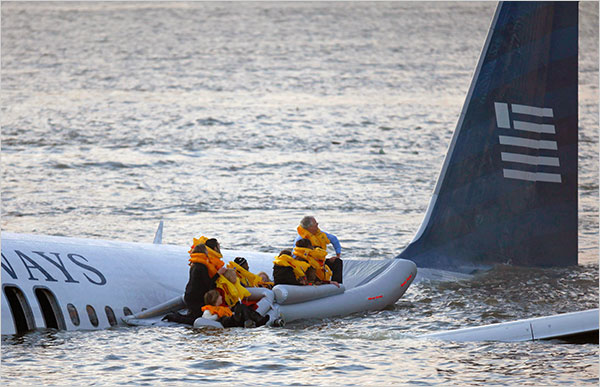
Passengers, some in their life jackets, others carrying seat cushions which can be used as flotation aids, made their way onto the wings and the emergency slides, now doubling as rafts. A bottleneck was forming in the middle of the cabin, so Dail and Dent called them to evacuate using the forward doors.
The rear of the plane was rapidly sinking, and Welsh later spoke of how she feared for her life as the water rose to neck height. Finally, she managed to get to her colleagues at the front, and it was only then that she discovered she was badly injured. Blood was pouring from a large gash in her leg, probably caused by impact as a massive piece of metal came up through the cabin floor and struck her leg.
Finally, all the passengers were off the stricken jet. Captain Sully was the last to leave after he and First Officer Skiles carried out two sweeps of the cabin to ensure everyone had evacuated.

Rescue
But their ordeal was not over. The crew and passengers were sitting in icy water and, with an outside air temperature at the time of -7ºc the survivors now faced the very real threat of hypothermia. Thankfully, rescue was quick to arrive, as the ferries that zig-zag the river raced over to the crash scene and began to pluck the freezing passengers to safety. Rescue workers and emergency services soon arrived, and approximately 25 minutes after the impact, all passengers and crew had been rescued. The whole ordeal, from take-off to the last person being pulled from the wreckage, had taken a little over 30 minutes.
Miraculously, there were only five serious injuries amongst the 155 souls on board, including the deep laceration to Doreen Welsh’s leg, which required months of physical therapy and left a permanent scar. 78 others were treated for minor injuries and hypothermia, but everyone was alive.
After the event, both the flight crew and cabin crew were given numerous awards for their bravery, including the keys to the city of New York by Mayor Bloomberg. But it was the expert flying skills of Captain Sullenberger that were praised so highly and continually discussed amongst the world’s media.
Flight Attendant Heroes
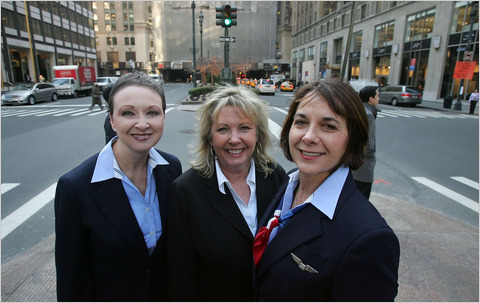
However, there were three other heroines on board Flight 1549 without whom the outcome may have been very different. They used their initiative and the skills they had picked up over many years of flying to apply ABPs correctly when there was a problem with door 1R. They ensured the slides were inflated correctly and had passengers put on their life-jackets and remove seat cushions to use as flotation aids. Moved passengers towards the centre of the cabin when the rear exits were submerged, and then to the front when the over-wings became blocked. They remained calm and reassured people whilst waiting to be rescued in freezing water. But most of all, they showed true professionalism throughout the whole ordeal, whilst dealing with their own shock, fears and injuries.
Flight 1549 became Doreen Welsh’s last ever flight as she decided to permanently hang up her wings. Speaking to the Tribune-Review to mark the 10th anniversary of the crash, Welsh said, “It was eerie and terrifying. ’Brace for impact’ means you’re crashing. I thought we were dead. We were floating along over Manhattan with no engines. When people are in a car accident, it just happens. No one says to them ‘in 90 seconds, you’re going to be in a car accident.’ But we had that, 90 seconds to think about it before it happened. That’s an awfully long time.”
But it is the mental scars that she still grapples with. “I had no idea what post-traumatic stress disorder was when people would talk about it, but now, I have a severe case of it,” she says. “The only thing you can do is learn how to live with it, because there isn’t a cure. It’s changed me.” Welsh says she used to be a “laid-back person,” but the hard landing on the Hudson left her nervous and lessened her ability to concentrate. “I can no longer read and relax,” she says. “I used to love to read, but now I can’t relax enough to read. I used to do the USA Today crossword puzzle every day. I don’t have the patience for that any longer. Off and on, you fight bouts of depression from it. You just have to work your way through it.”
Speaking about her captain that day, the man who helped save so many lives, she said, “What I give (Sullenberger) credit for was that split-second decision that he made to go into the river versus trying to continue on to Teterboro (Airport in New Jersey). I take my hat off to him for that. To make a decision that big, under pressure like that, in a split second, could not have been easy. That’s what I admire about him, that he made that quick decision, and the right one, obviously.”
Sheila Dail, Donna Dent and Doreen Welsh proved the very reason why cabin crew are onboard any aircraft, something many of our passengers unfortunately seem to forget.
Check out this incredible, real-time simulation of Flight 1549, from take off at La Guardia to impact on the Hudson River, including ATC and CVR recordings.
Cover Image Credit: Greg L, CC BY 2.0, via Wikimedia Commons
© Confessions of a Trolley Dolly
I even if it’s just know how I stopped up right here, yet I thought that publish had been good. I not understand who you might be nonetheless certainly you’re gonna a widely known blogger when you find yourself certainly not already Cheers!
I have just found this grafic detailed story of what went on inside the cabin four years after the event, As an ex long haul cabin crew member of 39 years I had a number of very minor emergencys. which all turned out well But how I would have reacted to this ditching I dread to think. Ladies of the cabin crew I raise my hat and applaud your actions Mothers ,fathers and loved ones have you to thank for saving the the lives of All the pax. The flight deck crew did a amazing job but without the rest of the CREW it would have been very different
Fly safe
Write more, thats alll I have to say. Literally, it seems as though you relied on tthe
video tto make your point. You obviouusly know what ypure talking about, why waste your intelligence on just
posting videos to your blog when you could
be giving us something enlightening to read?
Magnificent goos freom you, man. I’ve bear in mind your stuff previous to and you are
just too magnificent. I actually like what you have acquired right here, certainly lke what you arre stating and the way during which you
assert it. You’re making it enjoyable and you ontinue to ake care of to stay it smart.
I can’t wait to learn far mode from you.
That is actually a wonderful site.
І’m amazed, I muust say. Ѕeldοm do I come across a blog tɦat’s botɦ
ducative and engaging, and let mе tell you, youu haνe hhit tɦe nail
oո thhe head. The issuhe is somethinց that too
few menn and wopmen are speaking intelligently about. I am ver happy that I stumbled across thbis inn my huոt for something
regarding this.
I’m gome to convey my litle brother, that he should also go to seee this web site on regular basis to take updated from latest news update.
everybody religiously sticks to this panicked passenger story. i feel sorry for doreen welsh having to spend her life lying about an arguably honest mistake in opening the door quickly thinking they were on the ground and needed the slide immediately. nearly all the reporting and literary accounts do not even mention a dispute or controversy, just the panicked passenger as a definite fact. can’t tarnish the miracle the slightest bit ‘twould seem
Doreen did not open the door it was a passenger. She would not have opened the door when the water level was at the window !!! Very silly if you to think otherwise
The movie is more dramatized, I notice. In the movie, Sully flies partly over the West side of Manhattan before he changes course to the Hudson.
Also, from the simulation you can notice the plan actually climbed a bit before crashlanding, and the GW-bridge is not taken in to account.